The maths education infrastructure
your school can’t prompt into existence.
SeedTree is a school workflow platform built around the STOP Method™. Ten-plus years of curriculum-aligned content, a trademarked methodology, and enterprise-level customisation — all in one platform.
Or — teaching maths yourself? Try Bridge Builder Module 0.1 free. One hour. AITSL-aligned certificate.
Free PD on the platform you’ll teach with.
SeedTree Studio is one-hour modules that retrain how you read multiplication, fractions, and algebra structure. Module 0.1 (As-Groups Foundation) is free, AITSL-aligned, and earns you a Bridge Builder Foundation certificate. No credit card.
Become a Bridge Builder — the primary teacher who builds the bridge to secondary algebra.
The Bridge — in one example
Year 4 — compute first
Two sums. No structure carried forward.
Year 4 — see the unit
“Four sixes plus three sixes — seven sixes.”
Year 7 — same reading
Three moats. None of them prompt-replicable.
AI app builders ship a quick interface. Schools need infrastructure that holds up.
IP Moat
829+ generators. 10+ years. Curriculum-aligned.
Year 3 to Year 12. SVG-rendered diagrams. Error taxonomy built from real classroom data — not synthesised prompts.
See the content libraryMethodology IP
STOP Method™ — trademarked, research-backed.
A structural approach that replaces rule memorisation with pattern recognition. Nine error types, one principle. Filed 2026-04-10.
See STOP Method™School-grade Infrastructure
Enterprise-grade workflow for schools.
Role groups, assignment base table, completion templates, exercise policies. Configurable per school. Audit-ready.
See the platformWhere do you fit?
Studio — Teacher PD
Become a Bridge Builder. Free Module 0.1, one hour, AITSL-aligned. PD on the same platform you teach with.
Try freeFor Schools
Workflow platform + content + methodology in one. Founding partner programme open.
Learn moreFor Teachers
Teaching tools, curriculum coverage, structural framework. STOP Method™ resources free for public schools.
Learn moreFor Parents
Help your child understand maths from definition first. Why they struggle, and what fixes it.
Learn moreReference deployment
Built and proven at SeedTree Academy — our internal Premium school.
Sample of the content moat
Definition First: Where Real Understanding Begins
Most students memorise answers. SeedTree students understand why — starting from Year 3.
Definition First: What is 1 Litre?
Common Misconception
“1 Litre = 1000 mL”
A conversion fact, not a definition
Definition First
“1 Litre = the volume of a 10cm × 10cm × 10cm cube”
Connects volume measurement to physical understanding
Why this matters: When students know 1L is a 10cm cube, they can reason about capacity, volume conversions, and measurement — not just memorise “1000 mL”.
From Primary to Secondary: Definitions That Grow
When students master definitions in primary school, they're ready to extend those ideas in secondary — not start over.
Primary (Year 3-6)
Multiplication Definition
“Repeated addition of the same number”
Division Definition
“Repeated subtraction: subtract 3 four times to reach 0”
Secondary (Year 7-12)
Extending the Definition
Same principle, applied to algebra
When Definitions Reach Their Limit
“Repeated addition” doesn't work here — we need a new agreement
When primary definitions are solid, students understand why secondary mathematics needs new rules — instead of feeling lost.
Read more about our approach on our blog →Complete Example:
See how our three-stage approach transforms complex algebraic problems into manageable learning.
Stage 1: Definition Mastery
Students first learn what each multiplication means in plain language.
Stage 2: Logical Development
Using their definition knowledge, students work through the logical steps systematically.
Stage 3: Fluency Training
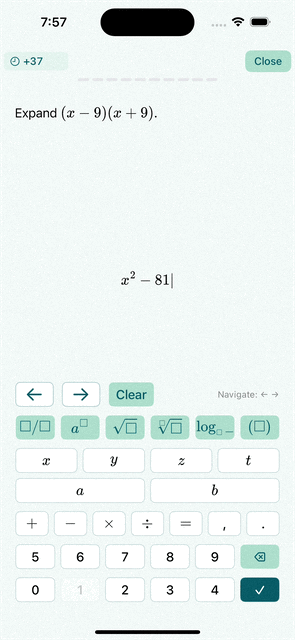
After mastering stages 1 and 2, students practice until they can solve complex problems mentally in one step.
This fluency training is achieved through our interactive Trainer app, which provides personalized practice sessions.
Learn about Trainer App →Real Problems, Real Solutions
See how SeedTree identifies and fixes common student errors
Proof
By squaring both numbers, students should be able to prove why is not equal to
📝Example Question
Current Approach
Most students get confused with this after memorizing:
They incorrectly apply multiplication rules to addition
Improved Approach
SeedTree guides students to:
Only the index form moves to the numerator, not the entire denominator including multiplier
Common Mistake
Incorrectly moving entire denominator
Correct Method
Only the index form moves up
Why this matters: Understanding the rules of exponents is crucial for algebra and calculus. SeedTree helps students see why rules work, not just memorize them.
SeedTree covers Year 3 through Year 12, building from primary arithmetic foundations to advanced secondary mathematics — all mapped to the Australian Curriculum.
Build deep mathematical understanding step-by-step.
Our three-stage approach: master definitions, develop logical reasoning, then build computational fluency.
Trainer
Interactive platform where students practice fluency training through personalized sessions to achieve one-step mental calculation of complex expressions.
Worknote
Structured practice platform for building computational fluency after conceptual mastery is achieved.